
Safe Fertilisers Newsletters - January to April 2011
Message from Les and Patti
 Ian amazing paradox, the recent floods have devastated
some land and crops, and also brought long awaited
benefits for others. The sad loss of loved ones can
never be overcome. It may take some time, but affected
farms will eventually return to normal. On the bright
side of the recent rains, the dams are full and the water
tables replenished.
Ian amazing paradox, the recent floods have devastated
some land and crops, and also brought long awaited
benefits for others. The sad loss of loved ones can
never be overcome. It may take some time, but affected
farms will eventually return to normal. On the bright
side of the recent rains, the dams are full and the water
tables replenished.
The key to the future of farming in those areas is careful
management. Now could be the time to investigate a
strategy for the implementation of sustainable farming, and
eliminate the need for the steroid type of fertilisers. Some
governments are now calling for the cessation of chemical
farm inputs to protect our valuable environmental assets.
The Queensland Government is particularly concerned
about the health of the Great Barrier Reef.
The first step is easy: talk to Safe Fertilisers agronomist,
Neville Janke, or an Alroc agent in your area.
The Four M's of Farming
Whether it is a gift from nature or human management, there is only one way to build rich, friable soil and that is with the four M's. Anyone with any doubts can just go into a rainforest and examine the soil. That soil that has had no human intervention, and is rich, friable and sweet smelling can grow huge trees and a diverse understory is a combination of the following ingredients - the four M's:
Mineral fertiliser is a stable, non-leaching combination of different types of mineral rock.
It will stay in the soil for years and is worked on by microbes to render it bio-available to the feeder roots of plants. Safe Fertilisers usually blend the crushed rocks with soluble fertiliser for fast results, however, the long term benefit is also there as a bonus.
Moisture is in great supply currently.
Now is the ideal time and opportunity to add mineral fertiliser and microbes to your soil. Huge tracts of Australia have just received monumental rains and flooding in some areas, and all of that moisture can be used to great advantage.
Mulch is generated on most farms, e.g. grain operations produce stubble and cane farms produce trash, both of which should be ploughed in.
Microbes can be present in soil, but to ensure an adequate proliferation, they can be boom sprayed onto the moist soil.
Good and inexpensive soil activators include Vital Activator and N-Rich, and for the organic growers, Activ-S. Nature works its magic with these four M's and turns them into humus. Humus is a colloid (rather like jelly), black in colour and sweet smelling. It will not be leached or evaporated out, and the inherent, nutrient-rich components will nourish plants via their feeder roots right through to harvest.
On The Road With Neville Janke
Biologically active systems provide quality returns',
was the take home message from the line up of
speakers with exceptional nutritional experience and
knowledge. Farmers appreciated the hands on approach
of the '8 Steps to Improvement' for
their individual operations.
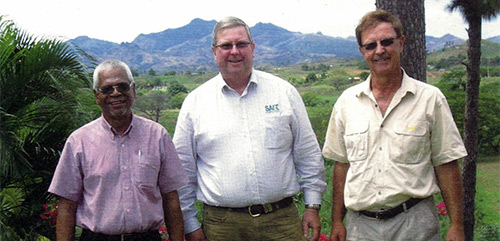
I visited Agchem, in the beautiful Fijian island group,
late last year. Agchem is one of our agents, which is
promoting Alroc Mineral Fertilisers throughout Fiji. Ben
Nand of Agchem guided me through the different areas of
food production and research stations, as well as tobacco
and sugar cane farms. The thirst for knowledge on how to
grow better crops, from all the people we met, was just the
same as we experience here in Australia.
2010 was a very trying year for some, and as one cane
farmer put it, "I stayed up on New Year's Eve just to make
sure 2010 was finished". Kevin Mann of Home Hill wrote
this to me, "The Sugar mills were only able to get off the
crop to about 70% and we only managed to harvest about
60%. We were in the path of nearly every shower of rain
across the season. Any results I have from this season are
very skewed and would not give a fair comparison on CCS
or tonnage. Blocks were cut over weeks, and not days,
and the sugar variance from start to finish had some large
gaps in the numbers. The differences were too big to be
normal. The only advantage we have is that our crop will
grow on to next year, weather permitting. I feel for the
producers in the southern half of the state as some have
gone through an absolute shocker and still are".
The New Year has dawned, and with it has come more
flooding. In some places rivers have peaked two weeks
running, The loss, devastation and heartache are the sad
part of any natural disaster. We now focus on rebuilding
and new growth in every trade and business. On a positive
note the rivers are full, and underground tables and wells
are replenished. All this takes away some of the dark cloud
and reveals the bright sunshine.
Farmers are set to take advantage of the best start
for a winter season in years with full profiles of moisture,
dams brimming and rivers running like the blood in your
veins, pumping the life-giving energy into every vital
system. Many growers I have spoken to talk of the plan
to remineralise the soil before planting this year are now
taking advantage of increased soil moisture levels. Some
paddocks of wheat stubble have been direct drilled with
mung beans using OAP Supablend as a starter and the
response is just magic.
Eight Steps to Improvement: The Farm Plan
Step 1: Soil Testing
A reliable Soil Test with a report is the first step to
improving any soil. Safe Analytical Laboratories measures
the elements that are essential to plant nutrition, pH levels,
etc. These factors are indicators of nutrient availability
and the potential of the soil to produce crops, CEC (Cation
Exchange Capacity) is the measure of soil's ability to hold
and store nutrient. Always assess the organic matter and
carbon levels in soil, which sustain the life within soil. Last,
but not least, measure the EC (Electrical Conductivity),
which is the total amount of charged particles in the soil
solution, An old saying goes, "If you don't measure it, how
do you manage it"?
Step 2: Crop Management
For summer crops or winter crops, Crop rotation is
always a good thing to break any pest/disease cycle,
and helps to open soil structure and build carbon levels,
Check on the rainfall data - when rains are expected and
when the hot dry times are noted, Does this soil have the
moisture holding capacity to grow the intended crop?
Step 3: Grazing Management
How many hectares are available for stock? Can a
stock rotation program be worked into the operation? Are
the water points accessible to work a rotation? Pasture
species - are they winter or summer dominant? Rotation
can assist in the control of weed pressures or pest
problems, Increase the benefits of pasture by growing
perennial grasses and cereals together, The improvement
of soil structure through the application of mineral fertiliser
assists roots to stimulate the microbial activity, Pasture is
, one of the best carbon sequencers; it converts CO2 into
carbon for the soils, This, together with soil microbes,
enhances photosynthetiC potential, thus producing a
greater volume of pasture,
Step 4: The Fertility Step
Feed the soil and it will grow the crop, The Soil Report
will assist in the decisions on which fertiliser to use, when
to apply, how much to apply and the critical timing part: at
ground preparation, pre-plant, at planting, in crop or tollat
Use the Safe Fertilisers consultant to help make these
decisions, Many options are available: granular or foliar
fertiliser; or is a custom blend what is required? Do I grow
a green manure crop, and how much organic matter is needed? Many questions have simple solutions in order to
grow a good crop - just ask a Safe Fertilisers consultant!
Step 5: Machinery
Some machines can cause soil structure problems, lead
to erosion patches and cause compaction. Have your soil
checked for structure, slaking or dispersing, as many soils
are ancient, strongly weathered and infertile, This can have
an effect on the tilth developed for a seed bed, The choice
of machines to be used, when the nature of the soil that
is being farmed is understood, can enhance the potential
crop growth,
Step 6: The Tractor
The power to perform the duties required is integral
to good farming practice, Too big or too small often
compromises the crop potential. Compaction is a big
problem - most times the tractor is too big or there is very
little organic matter in the soil. The condition of soil plays a
big part in the effect of a tractor doing its job in towing the
plough, Assess the power needs for the size of farm and
the job to be done, The fertility of soil has a big bearing on
the needs for power to perform the farm tilling,
Step 7: Recreational Tillage or Spraying
Non-essential time filling, Farm management decisions
on when to plough or when to spray are some of the most
critical a farmer will make, If unsure, ask the questions
when faced with these decisions, Should I really spend
my spare time engaging in these tasks? What is the best
option? Would I be better off taking a rest when there are
Issues like: too wet, too dry, too much wind, too hot or cold,
rain predicted, no soil moisture left, the weeds are getting
away, there are pests, etc? If in doubt, free advice is never
far away, call your Safe Fertilisers consultant.
Step 8: Harvest Time
Reaping the rewards of the decisions made, and the
kindness of the natural weather systems, Some options
can provide the extra cream - can the crop be harvested
on the green side and dried, do we spray it out, is a
contractor required or does the farm control the harvesting
equipment, is storing the crop waiting for a good price an
option? A fine line exists between quality returns and a
disaster, Remember that the fertility of the soil has a large
bearing on the quality at harvest.
Safe Fertilisers Newsletters - December 2010
Message from Les and Patti
We know that if the Birdsville Cup is washed out that
Australia is getting an awful lot of rain! This augers
well for future bumper harvests. However, we should spare
a thought for all the soil inputs that have been leached
down river and the enormous financial loss to those
affected growers. This is one of the very good reasons
to change to rock mineral fertiliser, with minimal loss
during heavy rainfall and lower input costs. Apart from
the financial rewards and the ecological benefits, there is
the long term bonus of improved soil structure with non-
erodible humus, which is the ultimate plant food.
Granular vs Foliar for Soil and Plant Nutrition
Many questions have been asked about the best way
to fertiliser. "Do I apply some granular or do I use a
tollar?" The way forward is to look at the benefits for each
application, and then apply the fertiliser suited for your soil
and plant needs.
Benefits of Granular Nutrition: SAFE Fertiliser
granular blends that both feed the soil and provide plant
nutrition, reduce the effect of depleting the soil of nutrients.
With a full spectrum of nutrients in the soil, the plant has
the ability to produce to its full yield capability. Applying
nutrients in a granular form is the most cost effective way
to build soil nutrient levels.
Benefits of Foliar Nutrition: This method enables the
farmer to fine-tune and control the provision of nutrients
directly to the plant. Foliar nutrition also allows for the
timing of specific nutrients to target growth stages of
the plant. Due to the direct availability of nutrition, foliar
fertilising enhances the quality of the produce whilst
improving the overall health of the plant, allowing it to build
up a resistance to pest and disease. Foliar fertiliser can be
used to counteract adverse soil conditions and to stimulate
the plant to take more nutrients through the roots. Liquid
nutrients are easy to apply over the top of plants, via a boom
spray or irrigation system, and through flood or trickle lines.
Report from Rohan Kingham of "Dalblair".
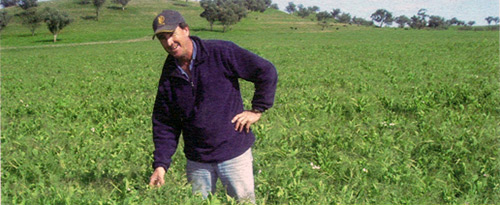
Due to the low price of grain over the past 5 years, the
cattle herd has expanded as the grain growing has
decreased. The increasing price of the inputs needed
to grow crops (especially fertiliser) was a determining
factor in reducing the amount of grain produced. Every
year the agronomist was telling us to increase our
fertiliser applications of nitrogen and phosphorus, and
our crop yields were staying the same. This meant we
were spending more money to achieve the same return.
I constantly maintained that the crop yields were always
determined by the one element that was most limiting,
and it didn't matter how much nitrogen you put on your
crop if it wasn't that limiting factor. I always thought it was
rainfall and I would not know till later that there were other
elements that were just as limiting. Another issue I often
asked the agronomist about was why 10 years ago we
would plant a crop and walk away from it until harvest time
without a problem. Now we face crop nutrient deficiencies,
pests (such as aphids), army worms and fungus attacks
(such as strip rust and net blotch). The only answer the
agronomists could give us was that these were due to
better crops being grown. Better for what?
Three years ago the Elias family purchased Dalblair and
Steve Elias showed me a pamphlet from Les Dyne (a good
friend of his). Steve told me that Les was producing this
fertiliser and to tell him what I thought of it. I thought it
looked interesting and we should see if we could speak to
someone about its merits. Then came my first meeting with
Neville Janke who I now regard as the most knowledgeable
person I have talked to about fertilisers, and plant and soil
nutrition. Upon our first introduction I had said that he was-
just another snake oil salesman selling fertiliser and he
would need to do some strong convincing to get us to
use this fertiliser! After about 2 hours of questions and
answers Neville had not only convinced me of this fertiliser,
but converted me to his way of thinking. All these years we
had been doing things back to front. We had been feeding
the plants when we should have been feeding the soil.
Since then, we have been using SAFE Fertiliser on
our grain and fodder crops, as well as on our native and
improved pastures. Our first use of the fertiliser didn't
give us greater yields, but produced the same yields with
less fertiliser in a balanced mineral blend. This blend was
cheaper and had given us the same outcome. We slowly
started noticing small changes. We always grow forage
sorghum and usually the crop would start to show signs
of running out of nitrogen and nutrients after two heavy
grazes at the end of summer. The agronomist would
always say that we had to put on more nitrogen as the
forage would start to yellow and go stripey. I would say
that we only have a month or two of grazing left, so I could
not justify the cost. After a year of using the mineral blend
on the forage, we would wait again for the yellowing to
appear late in the season. But this time it didn't appear!
The crop remained healthy right up to the first frost. That
same year We applied mineral blend to our barley crops.
Come harvest time, the season had cut out and the yields
were down in the whole district, as were ours, Interestingly
though, the neighbors were all complaining the protein
was even too low for the barley to be graded as malt. I
thought ours would be the same until I got it tested to find
it had been accepted as malt. The crop had only done 1 %
better for protein than the district, but that was enough to
get it into malt and a $40 per tonne premium.
On The Road With Neville Janke
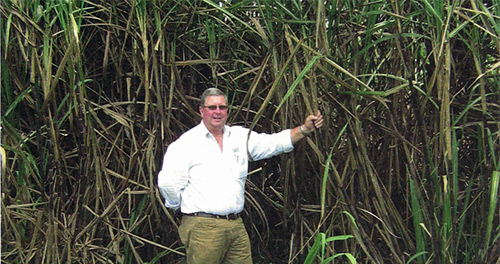
However, the banana prices are down and the quality in
the sugar cane is low due to the effects of a very wet .
start to the year, which has taken its toll as the crops go
to harvest. The sugar mill at Babinda had only seven days
of production in four weeks and there is more rain on the
way. The very wet winter this year has seen lower sugar
levels. There is some good news! I visited a number of
demonstration plots that I have been involved with and, as
the photograph shows, the cane is ready to harvest. It was
very interesting to observe the extra canes per stool and
the increased thickness of the stem in those areas that are
on a program with mineral fertiliser and reduced nitrogen.
It will be very interesting to see the difference in yield and
sugar levels at harvest.
Inspecting the turf at the Hillside Turf operation was
rewarding. The results can be seen from reducing
the chemical use and building organic carbon levels
to produce good strong turf ready for market. Ivan and
Jason have been following a program to build up the
mineral levels in the soil to reduce the fungus and disease
problems associated with a very high rainfall and humid
conditions in the Proserpine area. Ivan says the results are
fantastic as he has reduced the spraying of fungicide and
has strong turf with no wastage. Jason says there is a bit
of money left in the bank so that is a real positive.
John Sweet organised two full days of looking at
farming operations and assisting farmers to improve
operations in line with Reef Rescue. We talked with groups
and presented the easy steps to incorporating minerals
into each operation with little disruption to their agricultural
program.
Farmers were impressed with the ease of
application and the ability to hold nitrogen close to the root
zone whilst giving the plant a full nutrient package. The
plant then uses natural carbon in the process of producing
sugar. The tour of farms opened the eyes of growers to
the simple truths that have been lost in the chemical
world; minerals are the foundation to life, and that it is cost
effective to grow healthy, good quality food.
Copyright © 2010 SAFE Fertilisers |
 |